Ponding Water Repair & Drainage Correction
Standing water on a low-slope EPDM roof is a membrane-life countdown, not a cosmetic nuisance — we diagnose the drainage problem and correct it at the source.
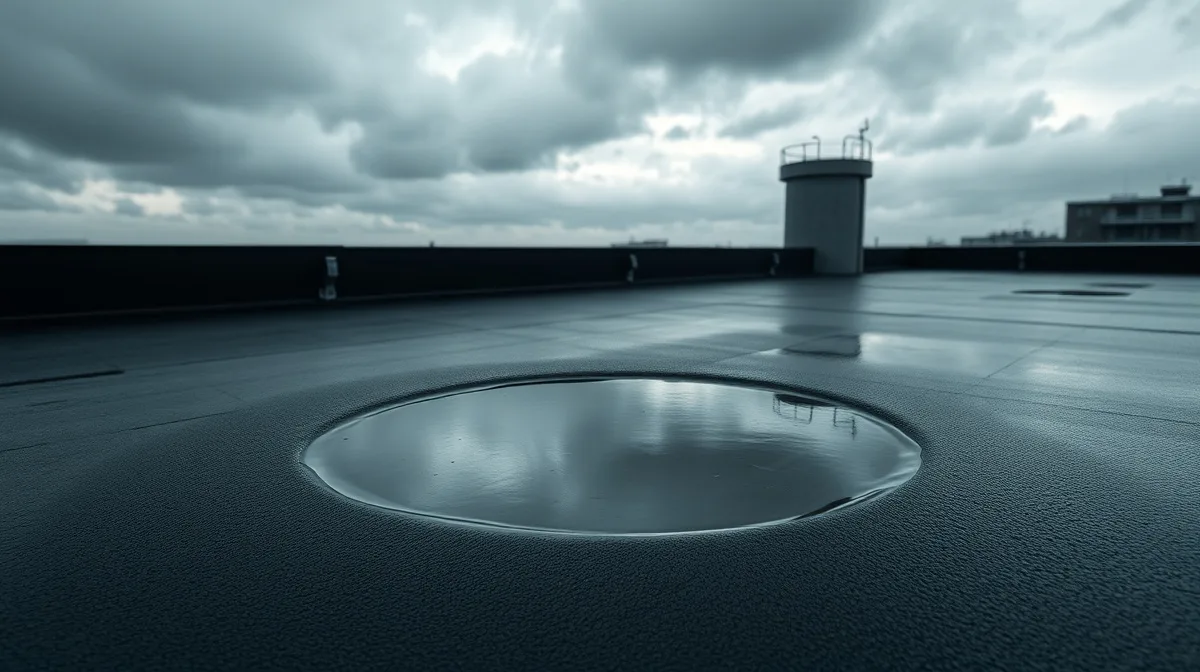
Every low-slope EPDM roof holds some water after a storm — that alone isn't a defect. The problem is water that doesn't clear within the industry-recognized 48-hour window. Past that point, standing water starts working against the membrane in ways that compound: it concentrates UV exposure in the ponded area even on overcast days as it acts like a lens, it keeps the rubber membrane saturated and softened far longer than the surrounding roof field, and it adds real structural dead load to a deck and insulation system that wasn't designed to carry standing water indefinitely. None of this shows up overnight. It shows up two, three, five years later as premature seam failure, membrane surface degradation, and insulation that's gone from dry and supportive to wet and compressible exactly where the roof needed it most.
We treat ponding water as a drainage engineering problem, not a patch-and-hope problem. That means walking the roof after rain (or flooding a test area when needed), mapping where water actually collects versus where the drawings say it should drain, and identifying whether the cause is a low spot in the original deck, insufficient insulation taper, a clogged or undersized drain, or settling that's developed over the building's life. Across retail boxes, warehouses, multifamily properties, and institutional buildings nationwide, ponding is one of the most common issues our crews are called out for — and one of the most fixable without a full membrane replacement, provided it's addressed before the ponding has already done its damage to the seams and insulation below.
Why property owners choose it
- Eliminates the accelerated UV and thermal degradation that standing water causes in seams and membrane surface.
- Removes the added structural dead-load risk that chronic ponding places on the deck and insulation system.
- Corrects drainage at the source with tapered insulation and crickets instead of masking the symptom with sealant.
- Identifies and repairs the specific cause — low spot, clogged drain, or insufficient slope — rather than guessing.
- Extends the service life of the existing EPDM membrane by removing its single biggest degradation stressor.
- Keeps the fix in repair-and-correction scope in the large majority of cases, avoiding a premature full re-roof.
Why Ponding Water Shortens EPDM Roof Life
EPDM is engineered to handle intermittent wetting, not permanent submersion. When water sits on the membrane past 48 hours, three things happen at once. First, standing water acts as a magnifying and reflecting surface, concentrating UV radiation on the membrane directly beneath and around the ponded area — this accelerates the same UV breakdown that normally takes 15-20 years to compromise seams, but focused on one section of roof. Second, prolonged saturation softens the rubber membrane itself, making it more vulnerable to foot traffic damage, debris punctures, and seam lifting in exactly the zone that's already under the most stress. Third, water is heavy — a single inch of standing water across a modest roof area adds thousands of pounds of load the deck and insulation weren't specified to carry as a standing condition.
The compounding effect is what makes ponding dangerous: a roof can look fine for years while the insulation underneath is slowly absorbing moisture and losing R-value and structural firmness, until a seam finally gives way in the ponded zone and the interior damage arrives all at once. We've found saturated, compressed insulation under ponding areas on roofs where the membrane surface still looked serviceable — the damage was happening below where a visual inspection alone wouldn't catch it.
- UV concentration under standing water accelerates membrane surface breakdown
- Prolonged saturation softens EPDM and increases puncture/seam-lift vulnerability
- Standing water adds structural dead load the deck wasn't designed to carry long-term
- Insulation beneath ponding areas can saturate and compress without visible surface signs
- Ponded zones fail first and disproportionately versus the rest of the roof field
The 48-Hour Standard and How We Diagnose the Cause
The 48-hour drainage benchmark is the industry reference point for distinguishing normal post-storm puddling from a real drainage defect. Our inspection process starts by confirming whether a property's ponding is chronic (same spots, every rain event) or occasional, then mapping the roof's actual drainage pattern against its intended slope. On a lot of commercial and industrial roofs built in the 1980s-2000s, we find the original design slope was minimal to begin with, or has flattened further over the decades from deck deflection, insulation compression, or structural settling — meaning what drained adequately at installation no longer does.
From there we isolate the specific cause: a low spot in the deck itself, a drain set slightly too high relative to the surrounding field, a clogged or undersized drain that can't keep pace with volume, or a broad flat zone with no positive slope at all. This diagnosis matters because tapered insulation, a cricket, and a drain replacement solve different problems — installing the wrong fix corrects nothing and the ponding returns on the next rain.
- Post-rain roof walks and, when needed, controlled test flooding to map real drainage patterns
- Comparison of current ponding locations against original design slope and drain layout
- Isolation of cause: deck low spot, drain height, drain capacity, or insufficient overall taper
- Documentation suitable for the property's own maintenance records or insurer requirements
Tapered Insulation, Crickets, and Drain Corrections — Repair Scope, Not Re-Roof
Correcting a drainage problem does not automatically mean replacing the membrane. In most cases we address ponding as targeted repair-adjacent scope: installing tapered insulation panels to re-establish positive slope toward existing drains, building a cricket (a small raised diverter) to redirect water around a low spot or obstruction like an HVAC curb, or replacing/relocating a drain that's undersized or set at the wrong elevation. The existing EPDM membrane is cut back, the insulation work is done underneath, and the membrane is reinstalled and re-seamed over the corrected slope — keeping the project in repair territory rather than triggering a full roof replacement.
Full replacement only becomes the right call when ponding has gone unaddressed long enough that the insulation across a broad area is saturated and structurally compromised, or when the deck itself has deflected enough that a taper-and-cricket correction can't realistically fix the slope. Even then, we tell property owners that directly rather than defaulting to replacement as the easier sell — the goal is the roof staying dry, at the lowest scope of work that actually accomplishes that.
- Tapered insulation panels re-establish positive slope toward existing drains
- Crickets divert water around low spots, curbs, and other roof obstructions
- Drain replacement or relocation corrects undersized or improperly set drainage points
- Membrane is cut back, insulation corrected, then reinstalled and re-seamed over new slope
- Full replacement is recommended only when insulation saturation or deck deflection make repair scope insufficient
Ideal for
- Roofs with visible ponding that hasn't cleared 48 hours after the last rain event.
- Buildings with recurring interior leaks near low spots even when the membrane itself tests intact.
- Properties where a prior repair patched a seam in a ponding area but the ponding itself was never addressed.
- Flat commercial and industrial roofs with known low spots, clogged drains, or drains set too high relative to the field.
- Facility managers who need a documented drainage correction plan ahead of an insurer or lender roof condition report.
What affects the cost
Ponding Water Repair questions, answered
If water is still standing more than 48 hours after the last rain, it's outside the normal range and worth having inspected. Chronic ponding in the same spot after every rain event is the clearest sign of an underlying drainage defect rather than incidental puddling.
In most cases, no. Tapered insulation, a cricket, or a drain correction can re-establish proper slope while keeping the existing EPDM membrane in place. Full replacement is only necessary when insulation saturation or deck deflection has progressed too far for a repair-scope correction to fix.
Correcting the underlying slope generally requires cutting back the membrane over the affected area so tapered insulation or a cricket can be installed underneath, then reinstalling and re-seaming the membrane. Surface-level fixes without addressing the insulation slope tend to have the ponding return.
Not necessarily, but it's a real risk the longer ponding has been chronic. We check insulation condition beneath ponded areas as part of the inspection, since saturated insulation loses R-value and structural firmness even when the membrane surface above it still looks intact.
Costs vary with the size of the affected area and root cause, but general commercial EPDM repair work runs roughly $4-$12 per square foot depending on severity, with major corrections in the $4,000-$8,000+ range. A free inspection gives you a firm number for your specific roof.
Ponding Water Repair done right, by a dedicated EPDM repair crew
Ponding Water Repair isn't a commodity — the result depends entirely on how carefully it's diagnosed and repaired. We inspect the roof, identify the actual cause (not just the symptom), and repair to the standard that keeps a roof performing for years, not months.
We serve commercial, industrial, retail, multifamily, and institutional properties nationwide — no fixed local footprint means no compromise on responsiveness. Every job starts with a free, no-pressure roof inspection.
Just as important, we treat your roof as a system. Seam condition, membrane age, drainage, and flashing all interact — fixing one while ignoring another leaves the door open for the next leak. When we scope your ponding water repair, we look at the whole roof, so the finished result actually holds up.
Free inspection
We evaluate your roof and give you a clear, itemized estimate with no pressure.
Expert repair
We diagnose and repair your ponding water repair to spec — clean and on schedule.
A roof you can trust
A durable repair and honest guidance on what it takes to keep your roof watertight.
Related services
Ready for a free ponding water repair estimate?
Tell us about your EPDM roof and we'll put together a clear, no-pressure repair estimate — commercial or industrial, anywhere in the country.