EPDM Repair vs. Full Roof Replacement
Not every failing EPDM roof needs a full tear-off. We walk you through the five factors that actually determine whether repair or replacement is the right call — and we'll tell you when repair is enough, even if replacement pays us more.
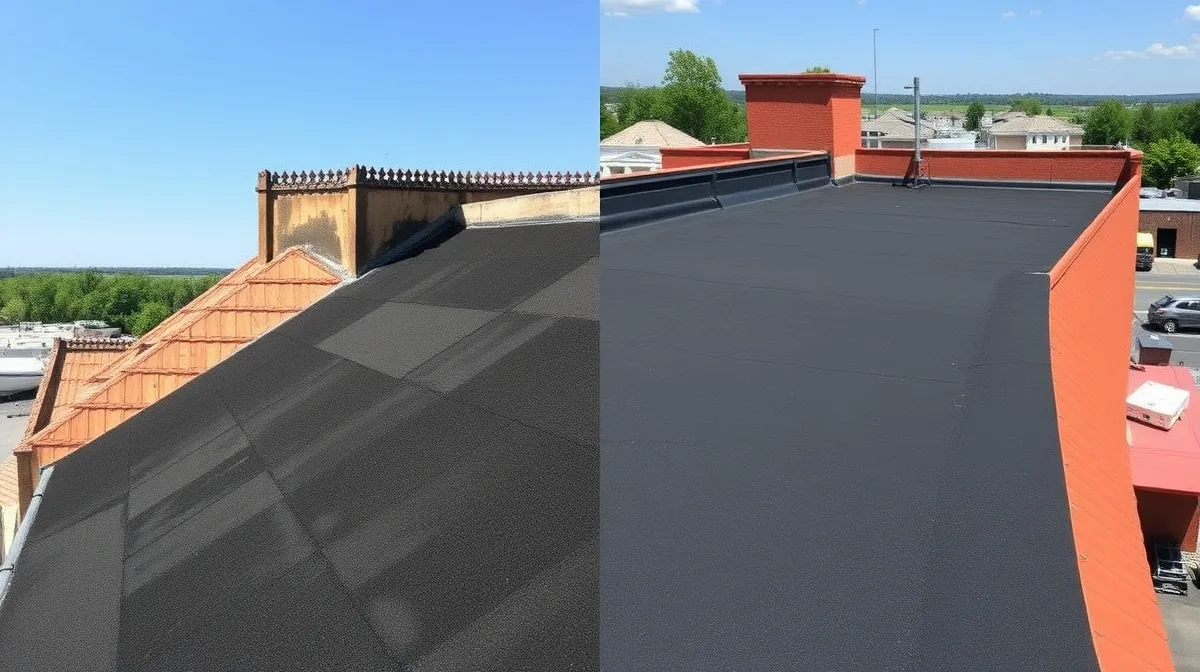
Every flat-roof owner eventually asks the same question: is it time to repair this EPDM membrane again, or is it time to replace it? The honest answer is that it depends on specifics most owners never get told — how old the membrane actually is versus its rated service life, what percentage of the roof surface is compromised, how many times this section has already been patched, how much of the roof holds water past the 48-hour drainage standard, and whether the insulation underneath the membrane has absorbed moisture. Get those five factors right and the decision usually makes itself.
We built our business on being the crew that will tell a facility manager "you don't need a new roof, you need three seam repairs and a drain correction" — because that's what keeps us the contractor they call next time, too. A roofing contractor whose only answer is "replace it" isn't giving you a diagnosis, they're giving you a sales pitch. Our inspectors document what they find with photos and moisture readings, walk you through what each factor means for your specific roof, and give you a straight recommendation — repair, targeted section replacement, or full replacement — with the reasoning attached. Nationwide, across retail, industrial, multifamily, and institutional properties, the goal is the same: the right scope for the roof in front of us, not the biggest invoice we can write.
Why property owners choose it
- You get a documented, factor-by-factor assessment instead of a one-line verbal opinion.
- Repair is recommended whenever the membrane and insulation genuinely support it, protecting your capital budget.
- Moisture-scan data on the insulation gives you objective evidence, not just a visual guess.
- You avoid paying for a full replacement when a targeted repair would have solved the actual problem.
- When replacement genuinely is the right call, you get the reasoning in writing to justify the capital spend internally.
- The same crew that inspects can execute either path, so there's no handoff delay or second sales process.
The Five Factors We Actually Measure
Age of membrane matters because EPDM seams and field membrane have a realistic service window of roughly 15-20 years before UV exposure and thermal cycling degrade the adhesive and rubber past reliable repair. A 6-year-old roof with a punctured seam is almost always a repair. An 18-year-old roof with the same puncture, plus visible seam lifting elsewhere, is a different conversation. Percentage of roof affected is the next factor — a handful of isolated failure points on an otherwise sound membrane is textbook repair territory, but when 25-30% or more of the surface shows seam separation, blistering, or thinning, patching becomes chasing failures instead of fixing them.
Number of prior repairs in the same zone tells us whether we're dealing with a membrane that still holds adhesion or one that's reached the point where every patch reopens within a season or two. Ponding extent matters because water sitting past the 48-hour drainage standard concentrates UV exposure and softens the membrane from below, and if ponding is chronic across a large area rather than isolated to one low spot, drainage correction or tapered insulation work becomes part of the scope regardless of the membrane's age. Insulation moisture content is the factor most owners can't see — we use moisture-scan equipment to check what's underneath the membrane, because a bone-dry insulation board supports repair even on an older roof, while soaked insulation under a young membrane can force a replacement conversation early.
- Membrane age vs. rated 15-20 year seam/field service life
- Percentage of roof surface showing active or developing failure
- Count and location of prior repairs in the same sections
- Square footage and duration of ponding beyond the 48-hour standard
- Insulation moisture-scan results beneath the membrane
What an Honest Assessment Looks Like
Our inspection isn't a walk-around with a verbal summary at the end. We photograph every seam issue, puncture, blister, and ponding area, run moisture-scan equipment across the insulation to flag wet zones that aren't visible from the surface, and note how many previous repairs are already on the roof and how they've held up. That documentation becomes the basis for the recommendation — not the other way around. If the data says repair, we scope the repair: which seams get reinforced, which punctures get patched, whether a drain or two needs correcting.
If the data says the membrane is past the point where repair is a responsible recommendation, we explain exactly why — which factors tipped it, and what continuing to patch would likely cost you in repeat service calls over the next two to three years compared to replacing now. We also flag the middle scenario honestly: sometimes a roof needs a large section replaced while the rest is genuinely fine, and forcing a full tear-off on sound membrane just because part of it failed is its own kind of waste. You get the full picture and a specific recommendation, not a hedge.
- Photo documentation of every failure point identified
- Moisture-scan readings on insulation, not just surface inspection
- Repair-history review for sections with multiple prior patches
- Clear scope recommendation: repair, partial replacement, or full replacement
- Written reasoning tied to the five deciding factors, for your capital planning file
Why We Recommend Repair When Repair Is Right
A roof replacement is a five- or six-figure capital expense for most commercial buildings, and we'd rather be the contractor a property manager trusts with that decision for the next fifteen years than the one who pushed a premature tear-off for a bigger invoice. When the membrane is holding adhesion, the ponding is localized and correctable, the insulation scans dry, and the failure points are limited to a manageable percentage of the roof, repair is the responsible recommendation — full stop. That's true even when it means a smaller job for us today.
This matters most on buildings where the roof has already had a few repairs — owners in that position are primed to assume replacement is inevitable, and some contractors lean into that assumption. We don't. If a targeted seam reinforcement and a drain correction will realistically buy several more years of sound performance, that's what we scope and that's what we recommend, with the data to back it up.
Ideal for
- Facility managers who've been told "replace it" by a roofer without seeing supporting data
- Owners comparing a large repair estimate against a full re-roof quote and unsure which is the smarter spend
- Buildings with a membrane in the 12-20 year range where the remaining service life is genuinely unclear
- Properties with a history of repeated patch jobs in the same areas that keep reopening
- Anyone budgeting multi-year capital plans who needs a realistic timeline for when replacement will actually be necessary
What affects the cost
Repair vs. Replace questions, answered
We document five specific factors during inspection — membrane age, percentage of roof affected, number of prior repairs, ponding extent, and insulation moisture scans — and the recommendation follows the data. If those factors support repair, that's what we scope, even though replacement is the larger invoice.
Yes, if the membrane is still holding adhesion and the insulation scans dry. What matters is whether the previous repairs are holding or reopening — a few solid patches with no new failures nearby is a different situation than repeated failures in the same zone.
It shows us whether water has gotten underneath the membrane and into the insulation board, which isn't visible from a surface walk. Dry insulation supports repair even on an older roof; wet insulation under a young membrane can push the recommendation toward replacement earlier than the membrane's age alone would suggest.
There's no single cutoff, but once active or developing failures spread across roughly a quarter or more of the surface, patching individual spots tends to become a cycle of chasing new failures rather than solving the underlying problem. We'll show you the documented percentage on your roof specifically.
Yes. If one section shows the age, damage extent, and moisture profile that calls for replacement while the rest of the membrane is sound and dry, we'll scope a partial replacement rather than force a full tear-off on roof area that's still performing well.
Repair vs. Replace done right, by a dedicated EPDM repair crew
Repair vs. Replace isn't a commodity — the result depends entirely on how carefully it's diagnosed and repaired. We inspect the roof, identify the actual cause (not just the symptom), and repair to the standard that keeps a roof performing for years, not months.
We serve commercial, industrial, retail, multifamily, and institutional properties nationwide — no fixed local footprint means no compromise on responsiveness. Every job starts with a free, no-pressure roof inspection.
Just as important, we treat your roof as a system. Seam condition, membrane age, drainage, and flashing all interact — fixing one while ignoring another leaves the door open for the next leak. When we scope your repair vs. replace, we look at the whole roof, so the finished result actually holds up.
Free inspection
We evaluate your roof and give you a clear, itemized estimate with no pressure.
Expert repair
We diagnose and repair your repair vs. replace to spec — clean and on schedule.
A roof you can trust
A durable repair and honest guidance on what it takes to keep your roof watertight.
Related services
Ready for a free repair vs. replace estimate?
Tell us about your EPDM roof and we'll put together a clear, no-pressure repair estimate — commercial or industrial, anywhere in the country.