Emergency EPDM Leak Repair
When an EPDM roof is actively leaking into occupied space, waiting for a normal service queue isn't an option — we prioritize active-leak calls, stop the water fast, and schedule the permanent repair before it becomes a bigger problem.
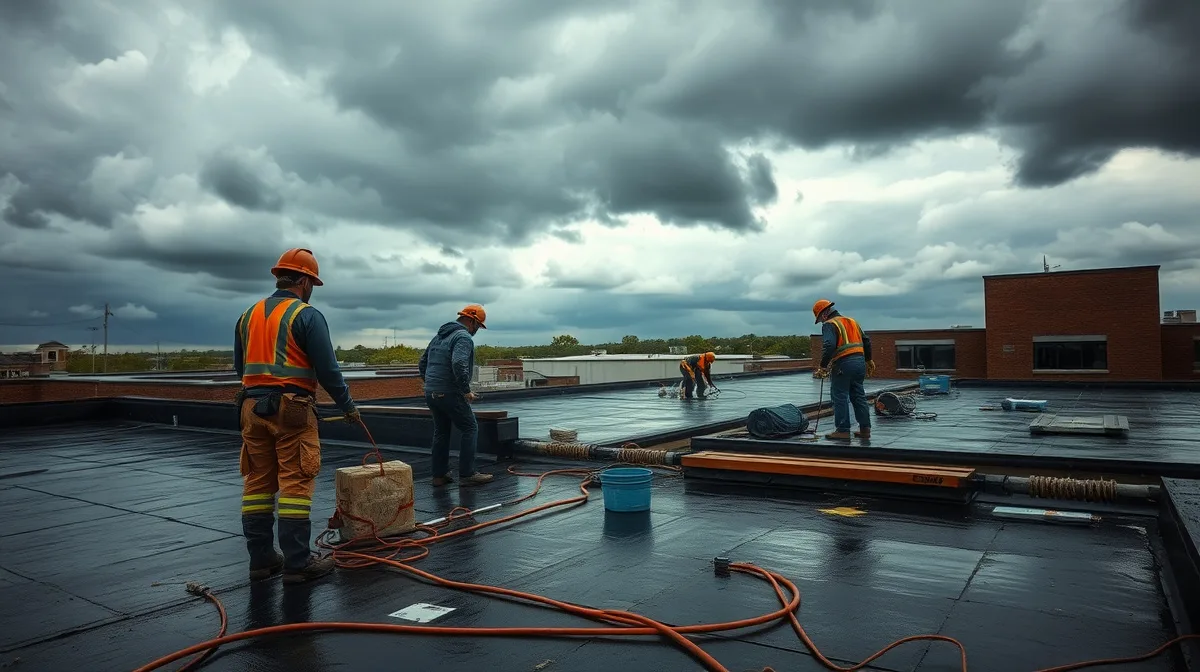
An active leak inside a commercial or industrial building doesn't wait for a convenient appointment window. Water finds its way through a failed seam or a torn section of membrane and starts working on ceiling tile, inventory, electrical, and finish work almost immediately. The longer it runs, the more the damage compounds — what started as a roofing problem becomes a tenant complaint, a maintenance ticket, and a documentation headache all at once. Facility managers calling us in this situation don't need a sales pitch; they need someone who understands that every hour matters and can tell them, plainly, what happens next, and who won't leave them guessing about timeline or cost while the ceiling keeps dripping.
Our emergency leak repair service is built around that reality. We prioritize active-leak calls ahead of routine scheduling, get a crew assessing the roof as fast as logistics allow, and stop the immediate water intrusion with a temporary dry-in before committing to the permanent fix. That sequencing matters — a rushed, improperly executed permanent repair on a wet or contaminated membrane surface often fails again within weeks, which means the building ends up back where it started, only with a second hole in the schedule and a second round of interior damage. We stabilize first, diagnose the actual failure point, then return to complete a proper repair, typically within the same week. Nationwide EPDM repair crews, no fake local storefront, no geographic restriction — just a response process built for buildings that can't afford an open roof, whether that's a retail space with customers underneath, a warehouse with product on the floor, or a multifamily unit with a resident calling maintenance every few hours.
Why property owners choose it
- Active-leak calls are triaged ahead of routine maintenance and scheduled repair work, so a facility manager isn't waiting in a normal service queue while water keeps coming in.
- Temporary dry-in (tarping, emergency patching, or sealant application) stops water intrusion the same visit in most cases, limiting further damage to ceilings, inventory, and finishes.
- Same-week permanent repair scheduling once the roof is dry enough for a proper, warrantable fix, rather than an open-ended wait for a follow-up visit.
- Crews document the failure point and interior damage extent for the property manager's own records or their insurer's requirements.
- Honest scope communication — if the emergency points to a larger membrane or replacement issue, we say so instead of quietly re-patching the same spot and letting it fail again.
- Minimal-disruption scheduling that accounts for occupied tenant space, active operations, or after-hours access needs, coordinated directly with the property manager on site.
What Happens When You Call
The first priority on any emergency call is triage, not paperwork. We gather what the caller can tell us — where the interior leak is showing up, roughly how long it's been running, whether it tracks with a recent storm or wind event, and whether the affected space is occupied. That information helps a crew arrive with the right materials already staged rather than discovering the problem cold. On most active-leak calls we're able to get someone assessing the roof within the same business day; the exact window depends on the property's location and current crew deployment, which is why calling as soon as a leak is noticed — rather than waiting to see if it gets worse — gives us the most room to move fast. For multi-building portfolios or larger facilities, we also ask which areas are occupied so the crew can plan access around tenants, staff, or equipment without adding to the disruption.
Once on the roof, the crew's job is to find the actual entry point, not just the spot where water is showing up inside. EPDM leaks routinely travel laterally under the membrane or along insulation before dropping through a ceiling, so the interior stain and the exterior failure point are often several feet apart. Locating the real source is what separates a repair that holds from one that reappears in a different ceiling tile a month later. That diagnostic step happens on the same visit as the temporary dry-in whenever conditions allow, so the property manager gets a clear answer — not just a tarp and a promise to follow up.
- Same-day or next-business-day assessment on most active-leak calls
- Interior damage and leak pattern reviewed before the crew goes on the roof
- Failure point traced independently of where water is showing up inside
- Materials staged in advance based on the reported conditions
Temporary Dry-In: Stopping the Water Today
In most emergency cases, the first order of business is a temporary dry-in — mechanically fastened tarping, an emergency cured-patch, or a compatible emergency sealant applied directly over the identified failure point. The goal is straightforward: stop active water intrusion immediately so interior damage doesn't keep accumulating while the permanent repair is planned and scheduled. A temporary dry-in is not a finished repair and isn't presented as one; it's a stabilization measure that buys the time needed to do the permanent fix correctly rather than rushing a patch onto a wet, contaminated, or still-moving membrane surface.
This distinction matters more than it sounds. EPDM seam adhesives and cured-tape systems need a clean, dry, properly prepared surface to bond correctly — applying a permanent patch to a roof that's still wet from an active leak, or during active precipitation, is a common way emergency repairs fail a second time. Tarping down the area, letting it dry, and returning with the right materials under the right conditions is slower by a day or two but holds. We'll tell a property manager exactly which step we're on and why at each stage, including a realistic estimate of when the roof will be dry enough for the crew to come back and finish the job.
From Temporary Fix to Permanent Repair
Once the area is stabilized and dry, we schedule the permanent repair — typically within the same week of the initial emergency call, depending on drying time and material requirements for the specific failure identified. The permanent fix uses the same standard EPDM repair methods appropriate to whatever actually caused the leak: reinforced seam tape and cover strips for a failed seam, a cured EPDM patch for a puncture or blister, or liquid-applied flashing detail work if the leak traced back to a penetration or parapet transition. Emergency response doesn't mean cutting corners on repair method — it means compressing the timeline around it so the building isn't carrying a tarp through the next storm.
Every emergency call also gets a straightforward assessment of whether the leak is an isolated event or a symptom of something bigger — an aging membrane with multiple prior repairs, or ponding conditions that made the failure point worse. If that's the case, we say so directly rather than quietly re-patching the same weak spot and leaving a property manager to deal with a repeat emergency call in six months. Documentation of the failure point, repair performed, and materials used is provided for the building's own maintenance records or their insurer's documentation requirements, and we're glad to walk a facility manager through what we found before the crew packs up.
- Permanent repair scheduled same-week in most cases once the area is dry
- Repair method matched to the actual cause — seam, puncture, or flashing failure
- Broader roof condition flagged honestly if it points to a bigger underlying issue
- Written documentation of the failure and repair provided for records
Ideal for
- Facility managers with water actively coming through the ceiling or visible on interior finishes right now
- Property managers fielding a tenant complaint about a leak and needing a fast, documented response
- Buildings where interior operations, inventory, or equipment are at immediate risk from continued water intrusion
- Situations following a storm event, high wind, or debris impact where the source of the leak isn't yet confirmed
- Any commercial or industrial EPDM roof where a known weak point (an old patch, a soft seam) has finally given way
What affects the cost
Emergency Leak Repair questions, answered
Yes. Active-leak calls are prioritized ahead of routine maintenance and scheduled repair work, and we can typically get a crew assessing the roof within the same business day depending on location and current deployment.
Most active-leak calls get a same-day or next-business-day assessment. Calling as soon as water is noticed — rather than waiting to see if it worsens — gives us the most scheduling room to respond quickly.
Yes. We typically stabilize the leak first with a temporary dry-in — tarping or an emergency patch — to stop water intrusion immediately, then return once the area is dry to complete a permanent, properly bonded repair.
No, and we're upfront about that. A temporary dry-in stops active water intrusion so damage doesn't keep accumulating, but the permanent repair — reinforced seam tape, a cured patch, or flashing work depending on the cause — is scheduled separately, typically within the same week.
Yes, that's most of who calls us for emergency work. We provide written documentation of the failure point and repair performed for the building's own maintenance records or an insurer's documentation requirements.
Emergency Leak Repair done right, by a dedicated EPDM repair crew
Emergency Leak Repair isn't a commodity — the result depends entirely on how carefully it's diagnosed and repaired. We inspect the roof, identify the actual cause (not just the symptom), and repair to the standard that keeps a roof performing for years, not months.
We serve commercial, industrial, retail, multifamily, and institutional properties nationwide — no fixed local footprint means no compromise on responsiveness. Every job starts with a free, no-pressure roof inspection.
Just as important, we treat your roof as a system. Seam condition, membrane age, drainage, and flashing all interact — fixing one while ignoring another leaves the door open for the next leak. When we scope your emergency leak repair, we look at the whole roof, so the finished result actually holds up.
Free inspection
We evaluate your roof and give you a clear, itemized estimate with no pressure.
Expert repair
We diagnose and repair your emergency leak repair to spec — clean and on schedule.
A roof you can trust
A durable repair and honest guidance on what it takes to keep your roof watertight.
Related services
Ready for a free emergency leak repair estimate?
Tell us about your EPDM roof and we'll put together a clear, no-pressure repair estimate — commercial or industrial, anywhere in the country.