EPDM Flashing & Penetration Repair
Parapet walls, HVAC curbs, pipe boots, drains, and skylights account for most EPDM roof leaks that start away from the open field membrane — and they need a different repair approach than a flat-field seam. We diagnose and repair every flashing detail on your roof and tell you honestly when a detail needs full replacement instead of another patch.
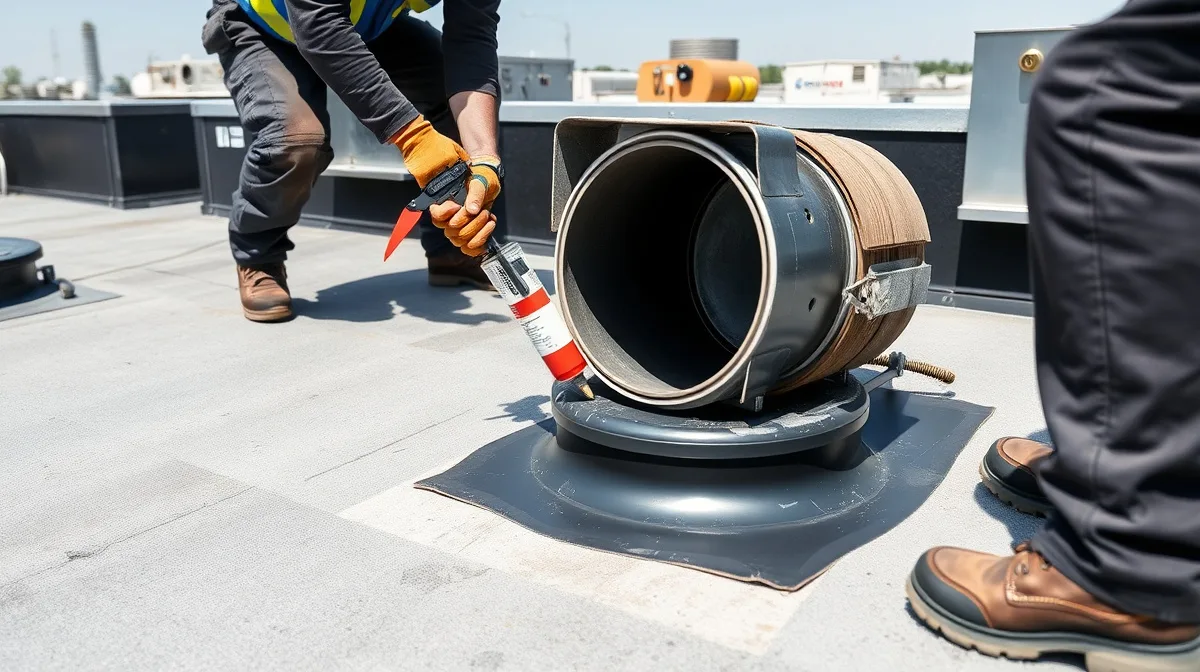
Flashing and penetration details are where an EPDM roof leaks first and worst. Parapet walls, HVAC curbs, pipe boots, roof drains, and skylight curbs all interrupt the open field membrane, and every interruption is a place where the roofing system depends on a mechanical or adhered seal instead of a continuous rubber sheet. Sealants, termination bars, and counterflashing metal move differently than the membrane around them, expand and contract at different rates through seasonal temperature swings, and take direct UV and wind-driven rain exposure at vertical and upright surfaces the field membrane rarely sees. Add foot traffic around HVAC units, vibration from rooftop equipment, and the sheer number of individual penetrations on a typical commercial roof, and it's easy to see why flashing details carry a disproportionate share of leak calls. On roofs installed 15-20 years ago, these details are very often the first thing to fail — well before the membrane itself gives out at a seam or in the open field. We work on flashing and penetration issues at commercial, industrial, retail, multifamily, and institutional properties nationwide, and we start every job with an inspection that traces the actual water path back to its source.
Not every failed flashing detail needs the same fix, and we don't treat them that way. A pipe boot that's hardened and cracked from UV exposure gets a different repair than a parapet wall where the membrane has pulled away from the wall termination, and both are different from a drain where the clamping ring has failed and water is tracking underneath the membrane rather than into it. Our crews carry liquid-applied flashing compounds for irregular shapes and corners, cured EPDM patch material and reinforced seam tape for flatter runs, and replacement termination bars and counterflashing when the metal itself has failed. We inspect the surrounding substrate at every detail we touch, because a flashing leak that's gone unaddressed for a season or more often means wet insulation underneath, not just a surface problem. When a detail has been patched repeatedly and keeps failing, we'll tell you that plainly and lay out what full flashing replacement at that location actually involves and costs — we're a repair contractor first, and we'd rather keep you out of an unnecessary re-roof than sell you one.
Why property owners choose it
- We inspect and repair every flashing detail on the roof — parapet walls, HVAC curbs, pipe boots, drains, and skylights — not just the open field membrane.
- Our crews carry liquid-applied flashing, reinforced cured tape, and cover-strip materials so we can match the right repair method to each detail's shape and substrate.
- We document existing flashing conditions with photos and notes you can keep for your own records or share with your insurer, without positioning ourselves as anything other than the repair contractor.
- Every flashing repair is inspected and installed to manufacturer detailing standards, not just patched to stop the immediate drip.
- We tell you plainly when a flashing detail is past economical repair and needs full replacement, instead of re-patching something that will fail again within a season.
- Nationwide licensed and insured crews respond to flashing and penetration leaks at commercial, industrial, retail, multifamily, and institutional properties across the country.
Why Flashing and Penetrations Fail First
Every flashing detail on an EPDM roof is a transition — a place where the rubber membrane meets something that isn't rubber: masonry, metal, wood nailers, cast iron, or glass. Those transitions rely on adhesives, sealants, mechanical fasteners, and cover strips to stay watertight, and every one of those materials ages faster than the membrane itself. Sealant joints chalk and crack in direct sun. Termination bars back out as fasteners loosen with thermal cycling. Pipe boots harden and split because they're a smaller, thinner piece of rubber taking the same UV dose as the field membrane around them. Add wind-driven rain hitting vertical parapet faces, standing water pooling against curb bases, and physical vibration from rooftop HVAC units, and it's clear why flashing details fail years before a well-installed field membrane does. On most of the commercial and industrial roofs we inspect, the highest-risk zones are consistent:
- Parapet walls — where the membrane terminates against masonry or coping, exposed to wind-driven rain
- HVAC curbs and equipment pads — vibration and thermal movement stress the seal around every unit
- Pipe boots and vent penetrations — rubber boots harden and crack faster than the surrounding field membrane
- Roof drains and scuppers — debris buildup and clamping ring failure let water track under the membrane
- Skylights and curb-mounted units — corner details and sealant joints are the most common failure points
Repair vs. Full Flashing Replacement — How We Decide
Flashing repair and flashing replacement solve different problems, and the wrong call in either direction costs you money. A detail that's failed once, where the substrate underneath is still dry and the surrounding material is otherwise sound, is almost always a repair — clean the area, prime it, and apply the right patch or liquid-applied material for the geometry of that detail. A detail that's already been patched two or three times, where the membrane has fully pulled away from a wall or curb, or where the counterflashing metal is rusted through, usually isn't a good repair candidate anymore. At that point another patch is a short-term fix that will fail again within a season or two, and full replacement of that specific detail — not the whole roof — is the more honest recommendation.
- Age and material condition of the existing flashing
- How many penetrations or details are affected versus a single isolated failure
- Whether separation is surface-level (repair candidate) or a full pull-away from the substrate (replacement candidate)
- Condition of counterflashing, coping caps, and termination bars
- History of prior patch layers already stacked on the same detail
Our Flashing & Penetration Repair Process
We start by probing every suspect detail, not just the one that's actively dripping, since flashing problems rarely show up in isolation. Failed sealant, loose fasteners, and old patch material get removed down to sound substrate so the new repair actually bonds instead of sitting on top of a prior failure. Depending on the detail, we apply liquid-applied flashing compound at corners, pipe penetrations, and other irregular shapes where a flat patch can't seal properly, or cured EPDM patch material with reinforced seam tape and cover strips on flatter runs like parapet walls and curb sides. Termination bars, fasteners, and counterflashing get replaced where the metal itself has failed, not just re-caulked over the top. Every repair is documented with photos and notes for your own records, and every job includes testing the repaired detail before we consider it complete.
Ideal for
- Property managers seeing active leaks at parapet walls, roof penetrations, or skylight curbs
- Facility managers with EPDM roofs 12+ years old where the original flashing has never been resealed
- Buildings with recently replaced rooftop HVAC units or new equipment curbs that weren't fully re-flashed to standard
- Owners who've noticed cracked, alligatored, or lifting flashing around drains and pipe boots during a roof walk
- Portfolios that need a pre-storm-season flashing audit across multiple properties
What affects the cost
Flashing & Penetrations questions, answered
Leaks at flashing and penetrations usually show up directly below or near a wall, curb, pipe, or drain rather than out in the open field — staining that follows a parapet line or radiates from a single penetration is a strong sign. A field inspection traces the actual water path back to its source before any repair starts.
In most cases, yes — flashing and penetration repairs are targeted, detail-specific work that doesn't require touching the rest of the membrane. Full replacement only becomes the right call when a detail has failed repeatedly or the surrounding substrate is compromised.
We recommend inspecting flashing and penetration details at least once a year, plus after any major storm or new rooftop equipment installation, since these details typically fail well before the field membrane does.
Not always, but new curbs and equipment pads are one of the most common sources of fresh leaks because the flashing tie-in isn't always finished to roofing standards. It's worth an inspection any time mechanical contractors have been working on the roof.
Liquid-applied flashing conforms to irregular shapes like corners and pipe penetrations where a flat patch can't seal properly, while cured EPDM patches with seam tape are typically used on flatter, more uniform runs like parapet walls. We choose the method based on the geometry of the actual detail, not a one-size-fits-all approach.
Flashing & Penetrations done right, by a dedicated EPDM repair crew
Flashing & Penetrations isn't a commodity — the result depends entirely on how carefully it's diagnosed and repaired. We inspect the roof, identify the actual cause (not just the symptom), and repair to the standard that keeps a roof performing for years, not months.
We serve commercial, industrial, retail, multifamily, and institutional properties nationwide — no fixed local footprint means no compromise on responsiveness. Every job starts with a free, no-pressure roof inspection.
Just as important, we treat your roof as a system. Seam condition, membrane age, drainage, and flashing all interact — fixing one while ignoring another leaves the door open for the next leak. When we scope your flashing & penetrations, we look at the whole roof, so the finished result actually holds up.
Free inspection
We evaluate your roof and give you a clear, itemized estimate with no pressure.
Expert repair
We diagnose and repair your flashing & penetrations to spec — clean and on schedule.
A roof you can trust
A durable repair and honest guidance on what it takes to keep your roof watertight.
Related services
Ready for a free flashing & penetrations estimate?
Tell us about your EPDM roof and we'll put together a clear, no-pressure repair estimate — commercial or industrial, anywhere in the country.